What could possibly be as awesome as Taaqtumi?
Why?! Taaqtumi Volume 2, of course! ✨
There's nothing like finding more of the kind of stories you're presently in love with!
I was in a trance after I finished reading Taaqtumi: An Anthology of Arctic Horror Stories. I didn't expect the stories to resonate with me so much that I'd write not one, not two, but three posts raving about them.
Firstly, it was my first foray into reading Indigenous fiction. I didn't know what to expect.
It was like a breath of fresh air. These stories were like nothing I had read in a long time. At the same time, there was something viscerally familiar about these tales.
Iranian-Canadian author, Maryam Rafiee, explains it best in an interview with Lisa Day over at Book Time on her book, Was It Worth It?
Lisa asks: I liked how there were stories about Canada and similar stories about similar situations growing up in Iran. How difficult was it to find comparable stories? What made you decide to work this way for Was It Worth It?
This was Maryam's reply:
That structure emerged quite naturally from the way memory works for me.
After I came to Canada, I would sometimes experience something that unexpectedly brought me back to Iran. A scene, a smell, an event or even an ordinary experience could open a door to an earlier memory. For example, experiences during the pandemic in Canada sometimes reminded me of what I had experienced as a child during wartime in Tehran. They were obviously very different circumstances, but the emotional memory could be surprisingly similar.
I became interested in those connections—the way two places separated by geography and time can suddenly exist beside each other in memory.
This line in particular, "They were obviously very different circumstances, but the emotional memory could be surprisingly similar", explained to me the connection I've been feeling between reading Indigenous stories and the gamut of memories they stir up in me, which often emerge from an entirely different part and time of my life altogether.
There's nothing obvious linking the two whatsoever, and this had been a source of doubt and conflict for me.
Was I somehow minimizing the experience the writers were asking me to imagine and believe in when their stories brought back a memory from my own life of something entirely unrelated?
As Maryam says, the 'emotional memory' is 'surprisingly similar', and now I can tell myself that that is reason enough to write in this manner that weaves threads from different parts of my life — the past me with all her childhood and growing up and adult life experiences and the present me that's reading these tales now.
So with renewed confidence, I am back here to write about Taaqtumi Volume 2!
I didn't even know such a thing of beauty existed. I love the Internet when it yields treasures like these. I tore through the stories in this volume at a breakneck pace, scarfing down the tales at the speed of greed.
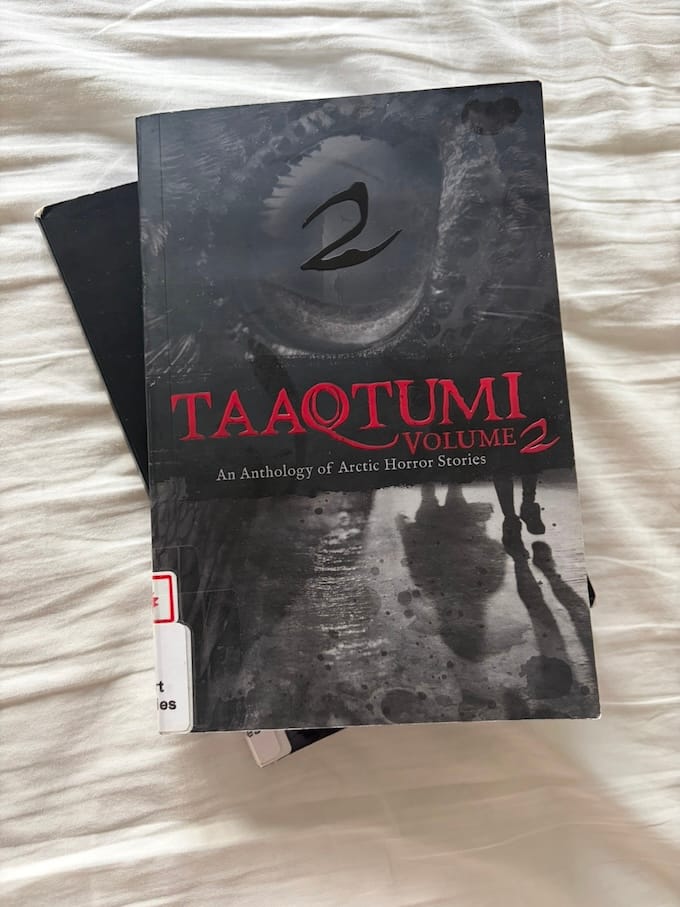
The very first tale, I Wouldn't Miss Them by Jessie Conrad, is a story of one woman's attempts to extricate herself from a situation of domestic abuse. At one point, her husband kicks her out of his truck and she's stranded by the roadside.
There was nothing funny about being ditched on the side of the road in winter. I didn't heed the old superstition that warns us not to cry outside at night or we'll attract evil spirits. If anything was going to take me, I thought, let it. I was at my worst here.
~ An excerpt from I Wouldn't Miss Them by Jessie Conrad, from Taaqtumi: Volume 2
I totally get this! The only time I'm not worried about spirits in a dark room is when I'm feeling really angry and at rock bottom. And these very words run through my head — If something's going to get me now, let it. I couldn't care less.
#
Another snippet that spoke to me was this:
In the morning, when the sun was rising, I started to pray. I didn't regularly pray back then, but it seemed like the right thing to do. Afterward I made coffee. This is when I heard them again, the voices from the hunting trip. I've learned in my old age that we all have protectors. Some of us can see them, while others only hear them, which is what was happening to me.
~ An excerpt from I Wouldn't Miss Them by Jessie Conrad, from Taaqtumi: Volume 2
#
My maternal grandfather was a man of unshakeable faith. He was a very simple man, with very few material needs. In fact, I only ever remember him wearing a white shirt and a white veshti, also a towel flung over his shoulder on most occasions, and the quintessential smear of holy ash across his forehead.
He was not one of those people who spent all their time praying to God while being nasty to their fellow human beings. Not at all.
He would go to the roadside temple for a few minutes of prayer every morning and evening, but spent the rest of his days after retirement reading horoscopes for people for free. He was so renowned that people from far-flung places came to him for advice. He never charged anyone for his 'service', which was essentially sharing his knowledge and expertise in the subject of astrology.
He had worked in the district government's administrative offices, starting as a clerk and rising up the ranks to a prominent position. After he retired, he secured a modest pension. He lived with Paati and their son and family.
No matter the situation life threw at him, he was always one to trust that he'd find a way through the difficulties and took the necessary action.
He had immense faith in God. It was a quality of his that my mother often admired.
I suppose it's a consequence of my mother's adoration that I too look up to my late grandfather and wonder — how was he so content and trusting?
He didn't have a whole lot. He didn't even travel outside of India. The farthest he had travelled was perhaps to Thane and Pune, when he came to visit us on a couple of occasions.
He had a childlike innocence about him. He was very ethical and strict about doing the right thing and staying away from those who engaged in illicit activities.
Anyhoo, the reason Thaatha came to mind is this line ... I've learned in my old age that we all have protectors.
I've been struggling to believe this. My faith in God, taken for granted until then, suffered a great wobble shortly after little D was born.
I remember hearing Dr. Shefali talk about conscious parenting, and once I heard her say that she believed children ought to be allowed to explore and inquire about faith and God and religion for themselves instead of being compelled to follow a doctrine or dogma handed down to them without question by their families and culture and society.
That statement made a lot of sense to me. It also occurred to me that most of the shlokas I learnt growing up had to do with beseeching God for protection from obstacles and difficulties and blessings of wealth and good health and prosperity.
Somehow, this kind of prayer went hand in hand with the belief that if you were a 'good' person, you could trust that your prayers would be answered. Which implied the opposite too. That if your prayers were not answered, it meant that God thought you were a 'bad' person.
But it was the birth of a child that opened my eyes to how little control we have over life and the events that unfold around us.
Whether we have a lot or a little in life may or may not have had to do with 'karma' (a concept I don't understand in the slightest) from this life or from past lives, but it definitely had very little correlation with how 'good' or 'bad' we were, how hard we worked, and how honest and ethical we were.
And so, caught in a conflict of my own about God and faith and religion, I felt thoroughly inadequate when it came to 'teaching' D about faith.
In fact, whatever little I've learnt about faith now has come from D.
D once asked me, "What happens after we die?"
I answered honestly, "I don't know."
A few days later, he himself came to me and said with fervent earnestness, "I know what happens after we die. We are born again. We come back."
He was only three years old then.
There have been several occasions when he has wished for something and it has eventually come true, in some form or the other, and he has remarked how his wishes are always fulfilled.
Perhaps that's faith and trust enough, without the need to add labels pertaining to religion and rituals and Gods.
#
Things didn't go as planned, though; they never do. The whistling gradually started, but the stench was with me the entire time. It smelled like carrion, heavy and rotten, making me gag. If hate had a smell, it would be that. I told myself it was a lone wolf, but knew better. It was a nàhgą, a bushman. I'm sure you've heard of them before. ... I always believed in them, but never in a million years thought I would encounter one. Some say they can be benevolent; others say they'll abduct you to eat or for other foul reasons I don't need to mention.
From my peripheral vision I caught a glimpse of it, crouching between the trees. Even then it was taller than me. I stopped myself from looking at it, although I wanted to.... Why is it that we want to see the things that scare us the most?
~ An excerpt from I Wouldn't Miss Them by Jessie Conrad, from Taaqtumi: Volume 2
#
nàhgą (NAH-gah) — a Tłı̨chǫ word meaning 'bushman' or 'night raider during earlier times'.
(From the Glossary at the back of the book, and from https://tlichodictionary.ca)
#
That's a very good question! Why is it that we want to see the things that scare us the most?
I've found that in my case, this is primarily true of physical things that cause me fear.
Snakes top the list. Also dark shadows that appear in the corner of my eyes, and when I turn in that direction to see them head-on, they disappear. Very innocently!
But when it comes to imaginary fears, my first reaction is that of avoidance, not confrontation!
My mind won't even entertain the possibility of the outcomes it most fears — rejection, invalidation, disapproval, being ignored.
It's often quite a task to quieten the mind and set out to do the task it wants to avoid in the first place. Funnily, taking action is what seems to shush its fears anyway.
#
It then dawned on me that I didn't need to convince them. Who cares if they didn't believe me? My life didn't depend on it. Still, I wanted to tell them more, ...
There's something about near-death experiences that makes people want to tell the world what happened; it's the pride of survivors. That makes it hard to be humble.
~ An excerpt from I Wouldn't Miss Them by Jessie Conrad, from Taaqtumi: Volume 2
#
Conrad hits the nail on the head with this one. The character's verdict on the predicament of near-death survivors brought to mind several books I've read that were written by, you guessed it, near-death survivors and their experiences of dying and what came after that before they came back to life.
I read them because I wanted to believe. I badly wanted to believe there was something after the end of life and I wanted to find out what that 'something' was.
Isn't that a demand of the ego? To insist that it should somehow continue to exist even after we've shed this mortal coil?
No wonder the author's use of the term 'pride of survivors' made immense sense to me.
Aviaq Johnston, whose short story, Iqsinaqtutalik Piqtuq: The Haunted Blizzard, in the first Taaqtumi anthology was equal parts mesmerizing and terrifying, has written another similarly compelling tale in this volume titled Maniittuq.
It begins with a young woman named Saa who's looking for her father in and around their cabin. At first she wonders if he's fallen prey to a polar bear attack. Her search for him leads her to other possibilities.
Ghost stories were commonly shared amongst children and teenagers, but "ghost" wasn't the proper term for most of the beings she'd learned about in her culture. Saa turned the words over and over in her head. They were a warning. What beings warned humans back? She could only think of tarriaksuit possibly fitting the description, known to her as a peaceful race of beings who lived invisibly.
~ An excerpt from Maniittuq by Aviaq Johnston, from Taaqtumi 2
#
tarriaksuit (tahk-REE-ahk-soo-eet) = a race of peaceful, invisible beings
(From the Glossary at the back of the book)
#
Funny how my attention drifts to the mention of another 'protector' entity.
In general I believe that the Universe is mostly benevolent and that events come into our life to impart a lesson or strengthen a particular skill that may be in need of honing.
But more and more often, it has been easy to think that the Universe is indifferent at best, and that life is often at the mercy of governments and tech bros and powers-that-be that mostly seem to have only their own interests in mind.
I'm certainly making an intentional effort to have the kind of unquestioned faith that D and my Thaatha have exhibited.
That it has to be done intentionally smacks a little of the 'Fake it till you make it' syndrome, which feels self-defeating in this case.
I do trust that clarity emerges sooner or later.
But I'm beginning to wonder — maybe there is some merit in intentionally choosing to adopt a certain belief, even if unproven, simply because it helps me wake up each day with more optimism and kindness and with less anxiety and fear.
Funnily, this predicament of mine reminds me of an excerpt from Johnston's other story, Iqsinaqtutalik Piqtuq: The Haunted Blizzard, in Taaqtumi (Volume 1), which I raved about at length here —
For some reason, elders and children know more than adults do, and I wonder why that is. They act like they know everything, as if everything has an explanation. At some point in their lives they forget the stories children are told, dismissing them as fairy tales and myths. They think that the scary women in the ice aren't real, or that the little folk that you can only see at sunset are just imaginary, or that giants never roamed the earth. Just like all adults, my mother has forgotten all those things the elders had passed down.
~ An excerpt from Iqsinaqtutalik Piqtuq: The Haunted Blizzard by Aviaq Johnston, from Taaqtumi
That's me! Guilty as charged!
Anyhoo, Johnston's storytelling is simply so vivid and engrossing that I've now picked up one of her novels and am thoroughly enjoying it. Of course, I'll come back here to write about Those Who Run In The Sky when I've finished reading it!
#
And now it looks like I'll have to rhapsodize about Taaqtumi 2 in more than one post! There are so many more stories that have touched me deeply, and I think it's a real privilege and a blessing to be able to take the time and write about those stories here — both the author's imagination as well as the experiences and memories it brings to the fore.
That's truly the beauty of reading, isn't it? A story is often not just a story. Many tales make you feel seen and understood. And every once in a while, some stories unexpectedly help you make sense of something you've been grappling with for years and didn't even realize it.
And the best part? None of these outcomes could have been engineered by the author or the reader.
It's some unexplainable connection through the aether, some spirit of life and energy shattering boundaries of geography and time and language, that sparks these new insights and jolts you awake and reminds you how precious these serendipities are. If one chooses to believe in them, that is.