books you may love: Long Road To Mercy (Atlee Pine #1) by David Baldacci
reflections on the notions of empathy, justice, and the greater good through the lens of David Baldacci's Atlee Pine series

About a month ago, I wrote about finding discriminatory writing in a work of fiction.
As I wrote at the time, I was determined to read more of the book before giving up on it, but the story just didn't hold my attention. About fifty more pages, and I decided it wasn't for me.
Either I was already biased against reading it, or I was perhaps not in the mood for a police procedural — it was all me, it was not the book.
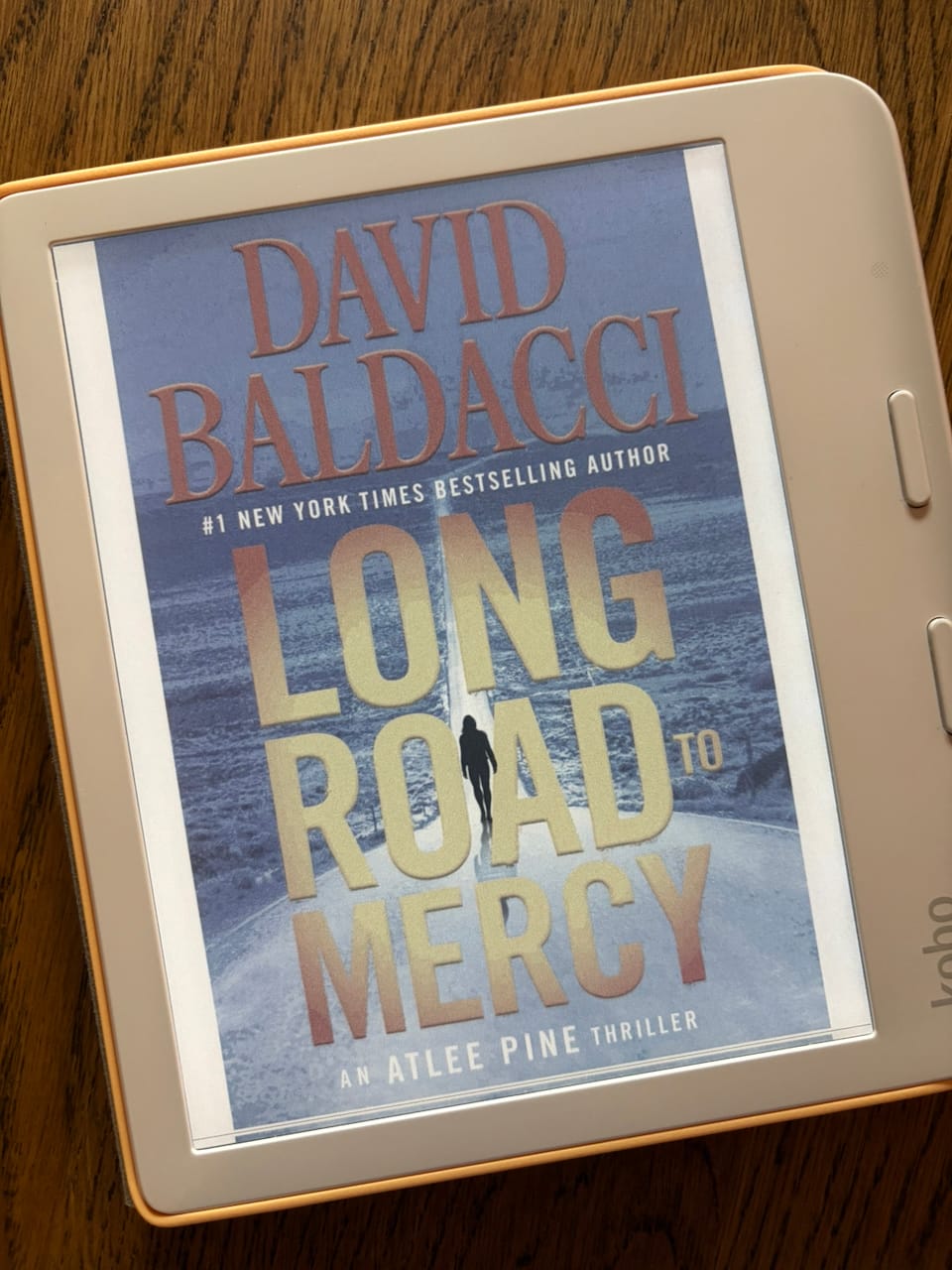
Subsequently, browsing through the library books available on Kobo via OverDrive/Libby, I came across David Baldacci's Long Road To Mercy. The premise was interesting and even though it's set in southwestern US, I decided to give it a go.
The story begins with FBI agent Atlee Pine turning up to meet a serial killer in a high-security prison. She's convinced that he's the one who kidnapped her twin sister, Mercy, by sneaking into their house at night and terrifying them out of their wits when the girls were only six years old.
Pine is now the FBI agent in charge of a place called Shattered Rock and is responsible for attending to crimes taking place in the Grand Canyon. She's called to investigate when a mule is found stabbed to death at the bottom of the canyon. The letters J and K were carved into its side. The man believed to have committed this ghastly deed is reported missing.
I began reading the book, subconsciously bracing myself for some insensitive remark against a non-white group, when I came across the following passage:
Her phone dinged and she opened the email. Blum had apparently enlarged the article so that it could be easily read. It took Pine a few minutes to go through it.
Back in 1909, two Smithsonian Institution-backed explorers named Jordan and Kinkaid had supposedly stumbled upon a remote cave high up on a sheer cliff in the Canyon.
Jordan and Kinkaid? J and K.
She read on.
On entering the cave, they had found evidence of an ancient civilization that might be, as the article said, using a long-discarded derogatory term, "Oriental" in origin, or even Egyptian.
~ An excerpt from Long Road To Mercy by David Baldacci
See? Isn't this proof that a story can entail racist terms while also acknowledging them for what they are?!
It reminds me of JK Rowling's portrayal of Draco Malfoy in the Harry Potter books. Malfoy's downright mean. Some of the things he says are quite shocking.
But the stories don't condone his actions. It's quite obvious — from the reactions of other characters — that his words and deeds are unkind.
Feeling gratified, I tore through the rest of the book and fell in love with Pine, her assistant Blum, and Pine's budding love interest, Sam. It was a riveting story entailing spies, Russia, North Korea, the US government, the US army, and even the ICC.
"I'm really sorry about all this, Agent Pine."
"It wouldn't be the first time someone wanted to murder me."
He let out a sharp breath. "Jesus, I don't know how you do a job like that."
"Funny, it's the only job I've ever wanted to do."
~ Long Road To Mercy
(Book #1 in the Atlee Pine thriller series)
by David Baldacci
There were several instances where I found Pine's character very sympathetic to vulnerable human beings.
In some ways—no, maybe in the only way—the figure of Justitia represented all there was in the world to Pine. Justice. It wasn't about the greater good. It was about what was right and wrong on an individual basis. Person by person. Because if you neglected the people, the idea of a greater good was a pipe dream created by those whose idea of the "greater good" almost always tended to favour themselves and people like them.
~ An excerpt from Long Road To Mercy by David Baldacci
#
More than a year ago, I watched a two-part Tamil movie called Viduthalai. It focuses on the dilemma of a newly recruited police constable who's part of an operation to capture Vaathiyar, the leader of an extremist group.
The leader is captured, and when the police escort him out of the woods, they strike up a conversation.
To paraphrase it, Vaathiyar poses the trolley dilemma to the police personnel escorting him. A runaway train is hurtling down a track where it is sure to run over five people and kill them. The alternative is to pull a lever and change course where it would kill only one person. What choice would you make?
People usually reason that killing one person is the better choice as it serves the greater good, i.e., saves the lives of five people.
This is the response the police officers give.
Vaathiyar then asks, "What if that one person were your mother?"
This leaves the officers speechless.
In the same vein, Vaathiyar argues, when a government decides to sacrifice the prosperity of one village for the betterment of a handful of others, can it really be deemed to be for the greater good? Would the politicians choose a village that was home to their loved ones?
This is exactly what Pine says in the excerpt above.
This also reminds me of Sam Altman's recent exhortation on AI that "the world should accept some bad things happening for the benefits of this technology and people having the agency."
Well, if history has taught us anything, this sentence means that Altman and his ilk will most likely reap the benefits of this technology and remain mostly immune to the bad things that will undoubtedly and disproportionately affect ordinary people like you and me.
Would people like Altman change their perspective if, God forbid, they or any of their loved ones were personally adversely affected by the technology they are developing and promoting?
Or perhaps they're so far gone that they'd consider any personal loss as a small price to pay for whatever transcendental glory or grandeur they seem to be seeking!
And it's not Altman or any other tech bro in particular. My question is this:
Who gets to decide what constitutes the greater good and who must bear sacrifices in the name of the greater good?
Because no matter who gets to decide this, they are most likely to decide in ways that favour them and people like them. Which would end up being only a small fraction of the vast world.
So I agree with Pine. It's not about 'the masses' as an abstract term. It's about doing right by individual people.
Hindsight held a level of perfection that real-time decision-making could not provide.
~ An excerpt from Long Road To Mercy by David Baldacci
#
"... I've found that people in power can be incredibly insulated and therefore unrealistic about what they can accomplish."
"Meaning they're stupid drunk with power," said Blum.
"A more accurate phrase, yeah."
~ An excerpt from Long Road To Mercy by David Baldacci
#
Fabrikant shrugged. "I don't know precisely. But there are some Americans in high places who admire the Russians. They think their model of governing is better in some important ways. They think the same about the Chinese, who can make decisions and instantly carry them out. Whereas democracy is messy and inefficient and often comes to a complete standstill. That makes an autocracy quite a tempting template of governance."
"Not for me, because in order to have that, you have to give up your freedom," retorted Pine. "I'll take the mess and the inefficiency."
"You give up your freedom in part," countered Fabrikant. "For benefits you otherwise would never have. I'm not saying I agree with that concept. I don't, in fact. But it's not so crazy that others don't believe in it. I can tell you, quite explicitly, that many in power do."
~ An excerpt from Long Road To Mercy by David Baldacci
#
What is a model of government that can truly benefit everyone? Is there a system that can truly benefit each group in the way they require?
In my few decades of living on earth, I have come to the humbling conclusion that world peace cannot really be achieved in the way many of us imagine it to be.
Where there are humans in close proximity, there's always bound to be conflict and disagreements. Whether we can resolve those conflicts respectfully is what determines the prevalence of peace.
There's also another passage I particularly loved because it shows Americans too are fundamentally no different than any other group of human beings, no matter how much they'd like to think otherwise.
Unlike the last time, Pine and Blum had taken a full week to drive cross-country in the Mustang. They had stopped along the way to take in more of America than either ever had.
Now they sat at a little roadside diner in Arkansas eating barbecue and drinking sweet iced tea at a picnic table while some little kids in T-shirts and shorts ran around playing tag. Pine said, "You know, this really is a beautiful country."
"It's actually lots of countries in one, and they each have their own individual beauty, and their own sets of issues." Blum bit off the end of a pickle after dipping it in hot sauce. "But there's a core of humanity and, oh, I don't know, values that we all share. Sort of the glue that holds us together." She paused and smiled. "It actually reminds me of my six kids."
"How so?"
"I can't remember one day while they were growing up that they all got along. Not a single day all those years. Someone was calling someone a name. One was hitting another. Two others were in a screaming match. And the two others were playing together and having a wonderful time. Then the next day they'd be at each other's throats."
"What do you take away from that?" asked Pine.
"All you can hope is that if one of them gets sick, or gets hurt, or really needs help, that the others will come to their aid. Other than that, I'm afraid all bets are off. Life is messy, and people are just deluding themselves if they think someone will just wave a wand and everyone will suddenly play nice in the sandbox. It's just not how we're wired, apparently." She paused once more to take a sip of her tea. "But I have to say, even with all that yelling and fighting, when there were good times, they were pretty damn great. Wouldn't trade 'em for anything."
~ An excerpt from Long Road To Mercy by David Baldacci
#
I finished reading Long Road To Mercy about a month ago. And several more books following this one. So I'm going to be playing catch-up when it comes to writing about all of them.
But I have several reasons for posting this today.
Firstly, after my last post on books was about Michael Connelly's The Late Show, lamenting about his character's discriminatory behaviour, I felt like I needed to come here and mention whether I had finished reading that book or not. It felt like unfinished business, so I needed to at least write here stating that it was a DNF for me.
Secondly, I have read so many awesome books in the past few weeks that I needed to come back here and start writing about them. At first, I thought I'd compose a single post and mention all the books in one go.
But clearly, looking at this post 👆🏽, that's not going to happen. Each book demands its own share of attention, and deservedly so!
After all, these posts are love notes to authors who write amazing books that stay with me long after the story is over. Their words shape how I think, make me feel seen, and, above all, give me courage to face these difficult times.
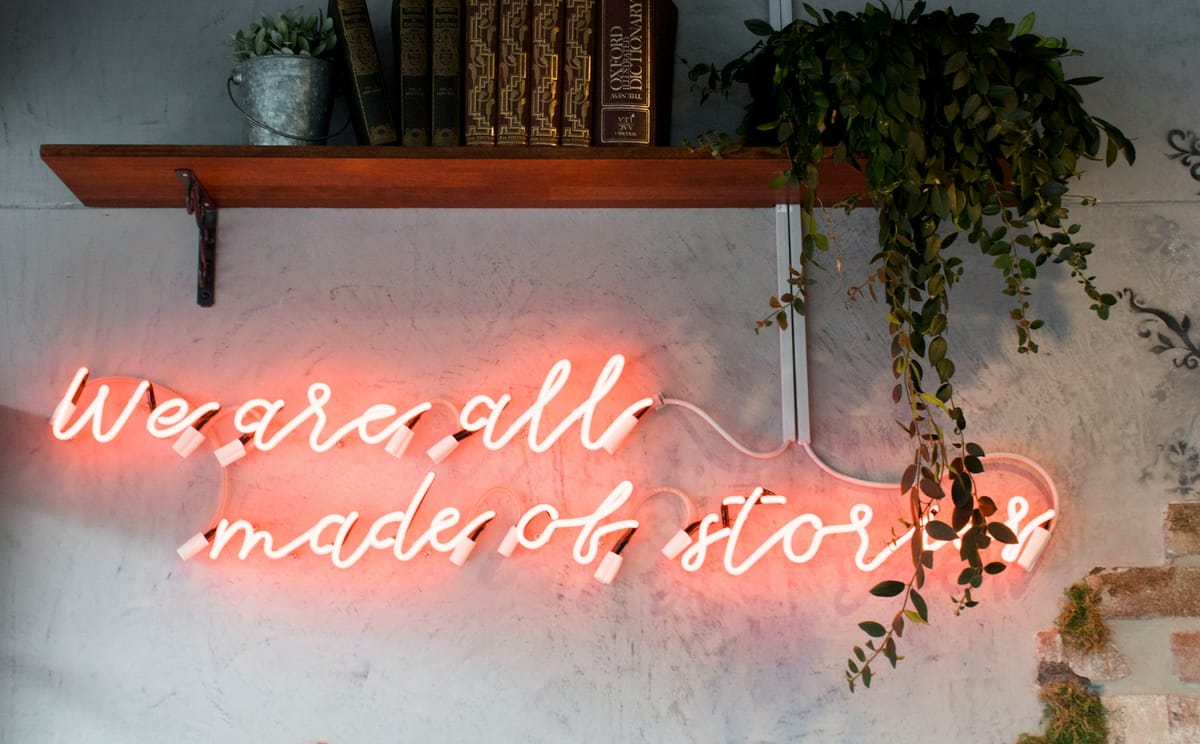
The least I can do is express how much their writings mean to me. Because, as the image at the top of this post states, "We are all made of stories."
And finally, I've just managed to borrow Book #2 in the Atlee Pine series! 🤭 So before diving into A Minute To Midnight, I wanted to record how much I appreciate Baldacci's and Pine's sensitivity towards hurtful terms and beliefs.
I'm off to read now. It's the perfect time of the year to read and write, to indulge in books and stories and appreciate the rich goodness that they bring into our lives. All they ask for in return is your presence and attention.