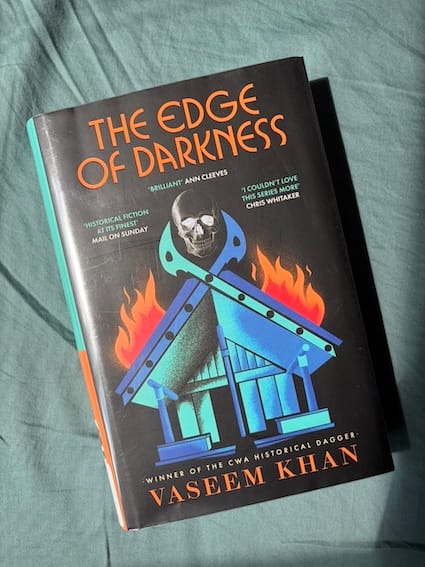
books you may love: The Edge of Darkness by Vaseem Khan
Book #6 of the Malabar House series set in post-independence India featuring India's first female police officer

I've loved Vaseem Khan's Malabar House series ever since I came to know of it, a few years ago now. I was eagerly awaiting my copy of Book #6 — The Edge Of Darkness — to pick up from the library and spent a lovely summer weekend reading yet another interesting murder mystery set in the background of post-independence India.
With one huge twist. Persis Wadia, the main protagonist, is no longer in Mumbai. She has been transferred to Nagaland, along with her boss, Roshan Seth.
I can't remember if the end of Book 5 hinted at this change of scenery. Nevertheless, the new setting made for a very interesting and informative read.
How delightful it was to learn a little of the history of this northeastern state of India through the lens of this historical fiction, locked-room murder mystery!
Before reading this book, I had absolutely no idea (and I admit this ashamedly) that Nagaland had sought to exist as an independent entity and many of its people were hoping to achieve this end as India fought for freedom from British rule.
The roles of America and China in keeping this insurgency alive came as an eye-opener too! It reminded me that the gamble that governments play with people's lives is not a new thing. Such callousness by the powers-that-be has existed since time immemorial.
Which makes me wonder — as I consider Quebec and Alberta in the context of Canada — if it is really possible to maintain an individual identity while remaining part of a whole?
I ask this question not only in terms of nations and their constituent provinces/states but also as individuals functioning with the systems of families and broader communities.
How much of myself do I have to give up or conceal in order to conform? How much of my individuality will my group/family/community tolerate? Is it even just on my part to expect anything more than acceptance and tolerance on their part?
I digress. But that is the remarkable beauty of a book that makes you think about it and the questions it raises in the reader long after the story has come to an end.
As always, I can express my admiration for the writer and this book only by means of a handful of excerpts.
'Why didn't you leave in 1947? Go back to England?'
'This is my home. I came out here in '31, the year after I graduated from the University of Manchester. I fell in love with the country. Frankly, I can't imagine going back to England. I have no one left there. No one alive, at any rate.'
Persis had heard similar sentiments. Brits who couldn't stomach the thought of returning to the Old Country, with its depressing climate and even more depressing financial prospects.
~ An excerpt from The Edge Of Darkness by Vaseem Khan
This is perhaps the same thing that immigrants feel too. Once settled in a new country, having fallen in love with the place and accustomed to life there, it'd be hard for them us to imagine going back to the land we left behind. Sometimes, there really is no going back.
The events of the evening swirled around her thoughts. She wondered, briefly, if she had become inured to horror. By the cases she had worked, the parade of the dead. A man had had his head removed from his body. In any other context, it was a vision of the macabre that would linger, not merely for the duration of an investigation, but long into the future.
But she wasn't just anyone. She was a police officer. A woman who had looked into the abyss, time and again. She had lost her mother aged seven. Death had come calling early and left its mark. The killing of Mohan Sinha — in a manner that, on the face of it, seemed impossible — was no more than a thrown gauntlet.
She recalled, now, her second meeting with the man. A humid evening out on the hotel's rear veranda. Venturing there, she had found the politician sitting in a cane chair, smoking a cigarette. Unusually, he was alone. For a moment, neither had said a thing.
Singha had looked at her, then looked back out into the night. 'It's human nature to romanticize that which we don't understand. Out there is a wilderness, a way of life completely alien to people like you and me. City dwellers. Children of a civilized world. What do you think they make of us?'
She had no idea how to respond to this. A full moon shone luminously in the sky above. A night bird exploded in the treetops below.
'We arrive out here,' Sinha continued, 'intent on showing the Naga how the world works, how it should work. And pretty soon we encounter the brute realities of the very nature we believe makes them children to us. They hate us. Not because we seek to suppress them, but because they can no more understand us than we them. Our only meeting point is death.'
~ An excerpt from The Edge Of Darkness by Vaseem Khan
#
The doctor had slipped into a posture of frightened mournfulness. She wanted to tell him that the dead were not to be feared. The dead could be grieved, pitied, even envied, but never feared. For in the act of dying they lost power over the living, save the power accorded them by those they left behind. For many years Persis had allowed her dead mother to exert such a power over her. But with the first murder that had fallen into her path, and the warrant that she had accepted for bringing justice to the soul of that mortal flesh, she had realized that she must learn to let go. It was the only way to prevent the darkness grinding your soul to dust.
~ An excerpt from The Edge Of Darkness by Vaseem Khan
You can tell I'm especially fascinated with any contemplation on death by any of the characters!
One of the things I love about Khan's writings is the way he's able to present many different points of view convincingly through the different characters. To such an extent that I came to empathize with them all!
He sighed. 'I suppose it is difficult for someone from a city as cosmopolitan as Bombay to understand. But the Naga have a distinct identity. India will swallow us, change us, until we become unrecognizable to ourselves.'
She bristled at his words, at the implied insult to the city of her birth. He realized his misstep. 'I have offended you. That was not my intent. But you, like Mohan Sinha, represent the Centre. You could not possibly understand our struggle.'
'Do you condemn the insurrection?'
He offered her a bloodless smile in reply. 'That is a very clumsy question and you do not strike me as a clumsy woman. For the record, I condemn all violence in this conflict — on both sides. Off the record: I may not approve of Baba Dao's methods, but he's fighting our fight.'
'By killing innocents.'
'There are no innocents in war, Inspector. Have you any idea what is happening out in the hills? The reports are suppressed. But word gets back to us. Shroff's soldiers have killed innocents. Torture is commonplace. Is it any surprise that the insurgents respond in kind?' Smoke rose around the mans's hooded features.
'Do you know who he is? Baba Dao?'
"No. And if I did, I would not tell you.'
'Delhi has labelled him a terrorist. If they find him, they'll make an example of him.'
'Death comes to us all. What better way to die than fighting for your homeland? We Naga have a saying: "a small bird can give birth to an eagle". The hills are small, but in Baba Dao we have given birth to an eagle.'
'Why are you so convinced that being part of India will be detrimental to the Naga?'
'If history has taught us anything it is that whenever a dominant culture imposes its will on a smaller populace, it is the latter that is inevitably destroyed. Annihilation by assimilation, that is the choice we face.'
~ An excerpt from The Edge Of Darkness by Vaseem Khan
#
It dawned on her that the Naga had probably saved her life. At the last instant, he had thrown himself at her, bearing her out of the way of the worst of the rock fall and taking the brunt of it upon himself.
What nameless instinct had made him do that? For a complete stranger?
The same instinct, perhaps, that propelled her own search for truth, that made humans better versions of themselves.
~ An excerpt from The Edge Of Darkness by Vaseem Khan
#
And one of my favourite passages of all comes towards the end of the book.
What was life anyway but a series of events over which you had only the illusion of control? A rollercoaster ride with no one at the controls, doomed to cycle around endlessly, clinging grimly on until the inevitable crash. In the end it simply boiled down to this: what could she live with in the pursuit of her own happiness?
~ An excerpt from The Edge Of Darkness by Vaseem Khan
#
In the Acknowledgements, Khan states: "As a novelist I consider it my job to entertain and inform, striking a balance between truth and fiction. I hope I have managed that."
As far as I am concerned, he has accomplished both with excellence in this book, and in all the earlier books too. The only trouble is that now I have to wait for the next instalment of the series!