books you may love: The Glowing Hours by Leila Siddiqui
A wildly imaginative fictional retelling of the summer of 1816 that birthed the idea of Frankenstein in Mary Shelley's psyche

I must tell you two very disparate things before I can talk about this book.
- The first thing is this — when reading historical fiction set in the UK and Europe, I've often wondered why Indian characters are rarely featured. After all, India was under British rule for much of the 18th, 19th, and early 20th centuries.
Several years ago, The Art of Inheriting Secrets by Barbara O'Neal came as a wonderful and surprising exception to that norm. So much so that it has stayed on my mind all this while.
But I've come across very little since.
- The second thing is this — I can't believe I don't have a record of this on my website, but many moons ago I read a book titled Mary, or The Birth of Frankenstein by Dutch writer Anne Eekhout and translated by Laura Watkinson.
A historical fiction novel, it unfolds during that fateful summer that Mary and Percy Shelley spend in Geneva in the company of Lord Byron and John Polidori. It is believed (or historically proven) that this summer was when the idea to pen the story of Frankenstein took seed in Mary's mind.
Now, put these two things together, and you have the madly delicious awesomeness that is The Glowing Hours by Leila Siddiqui.
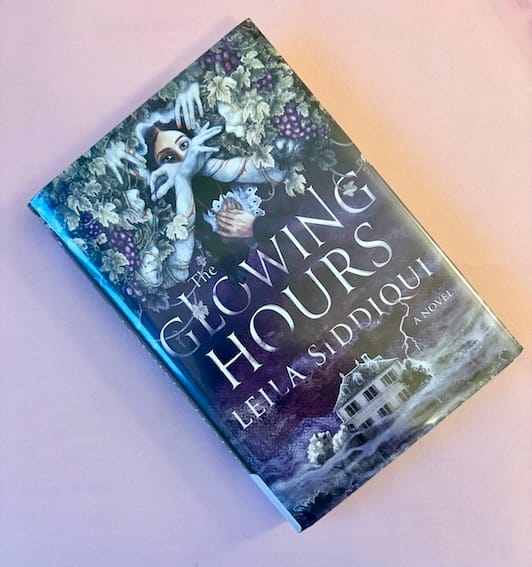
It's 1815, and Mehrunissa Begum, daughter of Sadaatunissa Begum, herself the daughter of the Nawab of Lucknow, descendant of Khwaja Mu'in al-Din Chishti, is aboard a ship destined for London.
She was born to an English father and an Indian mother, and has a brother named James. Her father took fair-skinned James when he was only a boy and left for England ages ago, leaving behind dark-skinned Mehr and her mother.
When her mother dies, Mehr is tasked with finding James and handing him their mother's will.
Only, when Mehr arrives in England, James is nowhere to be found. Instead, a woman named Miss Christy offers Mehr boarding in a home for solitary Indian women, abandoned by their English employers when their services as aayahs (nannies) were no longer needed.
It takes Mehr a few weeks to come to terms with her difficult situation. She doesn't have money to return to India, so she'd have to look for work in England. As a housemaid, at best.
Mehr ends up in the house of Percy and Mary Shelley, and travels with them to Geneva in the summer of 1816 where she encounters Lord Byron and John Polidori, both of whom are intrigued by this Indian woman.
The story unfolds in this setting and we see each character and their quirks and obsessions from Mehr's perspective. To top it all, everyone is haunted by their own kinds of monsters.
Mary sees the ghost of her mother. Percy sees his children from his previous marriage, which hasn't yet been annulled. Polidori is haunted by two former patients of his. Byron cavorts with a strange, seemingly lifeless spectral avatar of his lover, Lady Caroline Lamb.
As the blurb says ...
Almost immediately, Mehr notices strange, ghostly events at the villa. The walls breathe, portraits shift, and phantoms appear like unbidden guests who refuse to leave. The weather is fierce and foreboding, showing no signs of softening its relentless pall. And as Mary Shelley begins work on what will become her earth-shattering literary phenomenon, Mehr finds herself trapped in the villa as the rest of its inhabitants descend into madness.
I have been thinking a lot lately about why I write and why I read.
This definitely has something to do with my recent decision to stop writing for the sake of earning a livelihood and to write for the simple joy of it.
The instant I decided to do that, I was able to go back to reading books without feeling guilty or overwhelmed or having that constant nagging feeling that I need to somehow figure out how the author wrote such a beautiful piece.
For a long time, I've believed that I write because I have something to say and that I want people to read it.
Now I've come to see that I write not to be seen or heard, but for the clarity of thought that comes with writing.
And when I want to be seen or heard, it is not writing, but reading, that I turn to.
This may sound antithetical at first. But think about it for a moment.
Don't we feel seen when a character like us appears on the screen or in the pages of a book we read?
Don't we feel vindicated when someone says or writes something that feels as though they had peeked into our minds and plucked out the thoughts that constantly haunt us but that we were too afraid to say aloud?
I'm currently reading Alain De Botton's The Consolations Of Philosophy, and I will write at length about it in a separate post.
But here are a couple of lines I read in the first chapter itself, which made me feel as though De Botton had held up a mirror to my psyche.
I sought the approval of figures of authority and after encounters with them, worried at length whether they had thought me acceptable. When passing through customs or driving alongside police cars, I harboured a confused wish for the uniformed officials to think well of me.
~ Alain de Botton, The Consolations Of Philosophy
I do this all the time, and I've always been deeply ashamed of my innate tendency to behave thus. But to see these lines in a book, to know of another human being who behaves likewise, made me feel seen and accepted in a way that had never happened before.
When I send out my Monthly Missives, people write back to me because they see themselves in my words. They share similar experiences or doubts and feelings. It is as if my words have somehow given them the permission to feel what they feel and to be OK with it.
But when I write and expose my inner world, it's not with a desire to be seen by others but with a more subconscious desire to be seen by myself, to know myself better, to understand myself a little more than before.
It's a subtle difference, but one that explains why people of colour can easily read and enjoy the works of white authors featuring predominantly white characters — they may not necessarily feel seen or heard in an individual way, but they can still recognize in the story the overarching theme of the colonial and post-colonial times they may have grown up in or lived through.
It's also a huge reason why the reverse doesn't necessarily hold true. It takes real effort on the part of, say, white people to read books by non-white authors. There's very little to relate to, especially if they've grown up in relative isolation from other cultures.
This is a conundrum that's best appreciated by the people of the global majority because our life experiences are entirely coloured by this context.
It's a global world with global connectivity, yet some of us can still choose the books we wish to read or the movies we want to see and set aside those we don't much care for. Whereas others are constantly and overwhelmingly aware of the effects of colonialism on their lives.
Anyhow, I've digressed tremendously. Or perhaps I've not.
Because when I read about how Mehrunissa Begum, daughter of Sadaatunissa Begum, herself the daughter of the nawab of Lucknow, a princess in her own right, resented having to work as a housemaid, I felt seen in my own struggles to get through household chores, especially after having grown up in India where maids took care of the dusting and the cleaning, and all I had to do was study hard and work hard, both of which I dutifully did.
It's taken me years to adopt a stance of dignity towards all kinds of labour, and draw my own boundaries around what kind of chores I'd do and how frequently and which ones I don't have the bandwidth for.
So now I enjoy cooking for my family, and I've decided not to spend time and effort on gardening. It's time and attention I'd have otherwise spent on D, and that is far more important to me in this season of my life. I make do by seeking delight in my indoor plants, frequent purchases of floral arrangements, and hanging baskets for the spring and summer.
Mehr's story was utterly fascinating, and I'm so glad I came across this gem of a book in my local library. What a blessing it is to lead a life filled with the joys of reading and writing!