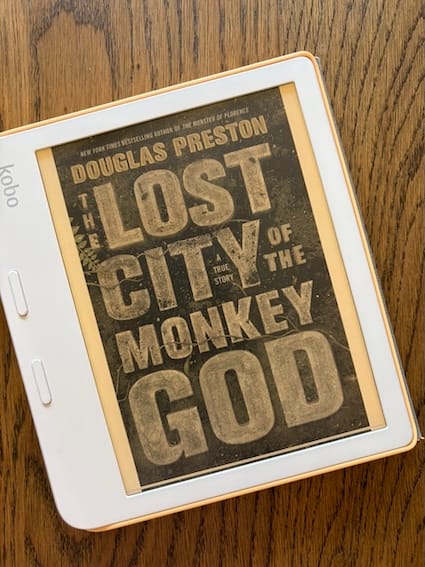
books you may love: The Lost City of The Monkey God by Douglas Preston
An engrossing and true tale of an archaeological expedition into Honduras. And, let's talk about fear of snakes, shall we?

I have an inexplicable fear of snakes.
There is a term for it. Ophidiophobia. I just looked it up.
It's one of the reasons — perhaps a really big factor — I've never gone camping.
Well, camping wasn't even a thing that featured in my middle-class upbringing in India as a child of the 80s.
I had the luxury of going on hikes because I spent several years of my childhood living at the foot of Yeoor Hills in Thane, in an apartment complex facing Upvan Lake. Back then, it was an idyllic settlement, far from the hustle and bustle of the city, quite literally in the lap of nature.
It was only after coming to North America did I find out how much camping was a part of life and childhood here.
I mean, if we're beset with comforts and conveniences all the time, no doubt we'd find a certain appeal in occasionally living rough, with only the bare necessities for survival, perhaps to get away from the noise of everyday urban or suburban life, perhaps to spend some time in awe of nature, perhaps to come back with a little more appreciation and gratitude for the ease of everyday life we're blessed with here.
The only ones who can appreciate living without electricity and water for a couple of days and find it to be an adventure are those who're blessed with an abundance of it otherwise and can make a deliberate choice to go without it for a while.
Anyhoo, I digress.
Coming back to snakes. When I visualize myself lying on a camp-bed at nighttime, I can't help but also visualize snakes slithering around the campsite, getting into my bed, or hiding in my boots.
I'm sure there are precautions campers take for these very possibilities. I'm also certain I wouldn't be able to sleep even a wink under such circumstances.
So when the first chapter of the book, The Lost City Of The Monkey God, by Douglas Preston, contained a visceral description of a venomous snake, I read, enthralled.
As for the hazards we would face in the jungle, venomous snakes were at the top of the list. The fer-de-lance, he said, is known in these parts as the barba amarilla ("yellow beard"). Herpetologists consider it the ultimate pit viper. It kills more people in the New World than any other snake. It comes out at night and is attracted to people and activity. It is aggressive, irritable, and fast. Its fangs have been observed to squirt venom for more than six feet, and they can penetrate even the thickest leather boot. Sometimes it will strike and then pursue and strike again. It often leaps upward as it strikes, hitting above the knee. The venom is deadly; if it doesn't kill you outright through a brain hemorrhage, it may very well kill you later through sepsis. If you survive, the limb that was struck often has to be amputated, due to the necrotizing nature of the poison.
~ An excerpt from The Lost City Of The Monkey God by Douglas Preston
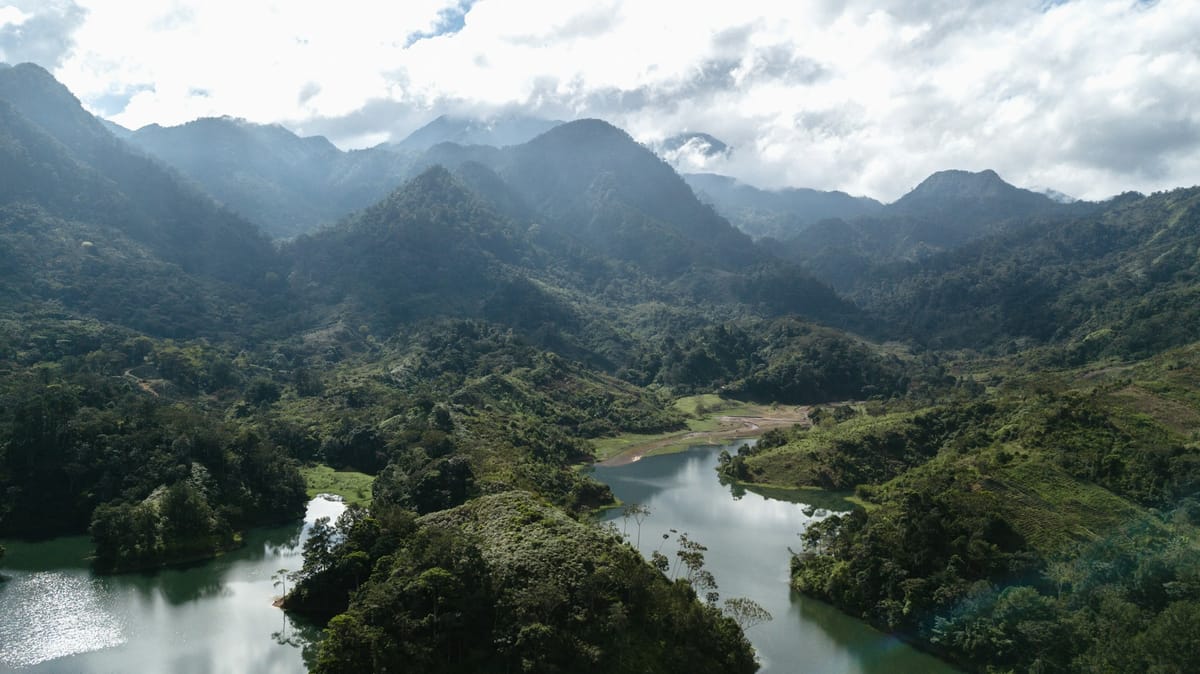
Preston's book details his adventures as part of a group of explorers and scientists that goes to Honduras to explore an area in a thick jungle that they suspect is the site of the legendary and mythical White City.
It was a thrilling read, to say the least. The author interweaves facts and events and presents all the different people involved and their roles and experiences with great storytelling ability.
One such person who played an important role in facilitating the expedition was Bruce Heinicke, described by Preston in the book as a
fixer, gold prospector, former drug smuggler for the Colombian cartel, and archaeological looter, who was instrumental in helping find the lost city.
For much of my life, I had a particular way of living. Every time I came across anyone who didn't follow that way of living, I'd judge them to be wrong or misguided somehow.
It's only in the last decade or so did I begin to realize that we all live our lives guided by our own perceptions and biases. Understanding this has made me much more curious and accommodating of different points of view, to the extent that I can sit in a group of people and think, "He is right", but "So is she", and "They too are right."
Because we all are doing the best we can based on how we view this world, each of our perspectives conditioned by our the unique combination of the circumstances of our upbringing, the culture of our times, the books we read, the people we meet, the times we live in, and so on and so on.
No wonder the following exchange between the author and Heinicke stuck with me.
I asked Bruce about his relationship with Steve Elkins and how their partnership worked.
"Lemme tell you a story. I was in a restaurant and some guys were mouthing off. I could see trouble coming. So I put a gun at this guy's head and said, 'Get the fuck out of here or you'll see all your fucking brains all over the fucking wall behind you.' That's the way I get things done. You gotta be that way down here. Don't fuck with that gringo, he will fucking kill you. When you're dealing with people like that, they got no respect for anybody, human life's not important, so you have to treat them that way or you will get walked all over. Steve thinks everybody is his friend. He wants to be their friend. And he doesn't understand that some people, they're just looking for a chance to rob you and maybe kill you. Steve trusts everybody and down here you just can't."
~ An excerpt from The Lost City Of The Monkey God by Douglas Preston
I am like Steve. Guess I need someone like Heinicke to be by my side in order to navigate this world.
As always, here are some excerpts from the book that spoke to me deeply.
#
As we thundered through the gap, a feeling of melancholy settled over me at leaving the valley. It was on longer a terra incognito. T1 had finally joined the rest of the world in having been discovered, explored, mapped, measured, trod upon, and photographed — a forgotten place no more. Thrilled as I was to have been a member of this first lucky few, I had the sense that our exploration had diminished it, stripping it of its secrets. Soon, the clear-cut mountainsides came into view, along with ubiquitous plumes of smoke, farmstead with glittering tin roofs, trails, road, and pastures dotted with cattle. We had returned to "civilization."
~ An excerpt from The Lost City Of The Monkey God by Douglas Preston
#
In Maya culture, the holy lords had a responsibility to keep the cosmos in order and appease the gods through ceremonies and rituals. The commoners were willing to support this privileged class as long as they kept up their end of the bargain with effective rituals. But after 650, deforestation, erosion, and soil exhaustion began reducing crop yields. The working classes, the farmers and monument builders, may have suffered increasing hunger and disease, even as the rulers hogged an ever-larger share of resources. The society was heading for a crisis.
Diamond writes: "We have to wonder why the kings and nobles failed to recognize and solve these seemingly obvious problems undermining their society. Their attention was evidently focused on their short-term concerns of enriching themselves, waging wars, erecting monuments, competing with each other, and extracting enough food from the peasants to support all those activities." (If this sounds familiar, I would note that archaeology is thick with cautionary tales that speak directly to the twenty-first century.)
Other archaeologists say this conclusion is too simple, and that the holy lords did indeed see things were going awry. They tried to solve these problems with solutions that had worked in centuries past: increased building projects (a jobs program) and more raiding (resource acquisition), both of which involved moving workers from outlying farms into the city. But this time the old solutions failed. The ill-advised building projects speeded up the deforestation that was already reducing rainfall, and it accelerated soil loss, erosion, and the silting of precious farmland and rivers.
~ An excerpt from The Lost City Of The Monkey God by Douglas Preston
#
We have few accounts giving the native point of view of these pandemics. One of the most moving is a rare contemporary eyewitness description, called the Book of Chilam Balam of Chumayel, which recalls the two worlds, before and after contact. It was written by an Indian in the Yucatec Mayan language:
There was then no sickness; they had no aching bones; they had then no high fever; they had then no smallpox; no stomach pains; no consumption... At that time people stood erect. But then the teules [foreigners] arrived and everything fell apart. They brought fear, and they came to wither the flowers.
~ An excerpt from The Lost City Of The Monkey God by Douglas Preston
#
Dressed in a guayabera shirt and a Panama hat, Hernández was not a tall man; he had a friendly, boyish face, and carried himself without any of the stiffness or pomp one might expect from the country's leader. Indeed, I had noticed that when people entered the T1 valley, a place so completely cut off from the world, distinctions and hierarchical divisions seemed to fall away.
~ An excerpt from The Lost City Of The Monkey God by Douglas Preston
#
Below is an excerpt that I was hesitant to share at first. Read on, and you'll see why.
The genes that resist disease can only spread in a population through the pitiless lottery of natural selection. People with weaker immune systems (children especially) must die, while the stronger live, in order for a population to gain widespread resistance. A staggering amount of suffering and death over thousands of years went into building European (and African and Asian) resistance to crowd diseases. One biologist told me that what probably saved many indigenous Indian cultures from complete extinction were the mass rapes of native women by European men; many of the babies from those rapes inherited European genetic resistance to disease. (The scientist, after telling me this horrifying theory, said, "For God's sake don't attach my name to that idea.")
~ An excerpt from The Lost City Of The Monkey God by Douglas Preston
I too was shocked at first after reading this passage. I didn't want to acknowledge the possibility of truth that these lines contain — because to accept that would mean to condone the brutalities inflicted upon the native people, isn't it?
Which is why I admire Preston's bravery (audacity?) to include this passage in the book. And I also understand why the unnamed scientist preferred to remain anonymous.
But to accept that a brutal incident made one stronger is not equivalent to condoning that event or wishing it upon someone else to bolster their strength and courage.
For instance, Britain's colonial rule over India brought forth several heroes who went on to play a crucial part in overthrowing the Brits and establishing independence. Does that mean colonialism can be condoned? Of course not.
Holding contradictory truths in the same space is hard. Mind-boggling even. But if that's reality, then accepting it without condoning the cruelty and horror, and without trying to shoot the messenger, seems like a reasonable thing to do.
To his credit, Preston goes on to write:
The Spanish, English, and others contributed mightily to the death toll through cruelty, slavery, rape, abuse, starvation, war, and genocide. Europeans killed many native people directly without the assistance of disease. In some instances, they intentionally used disease as a biological weapon by, for example, giving Indians smallpox-infected blankets. And millions more Indians died of disease who might have survived, had European brutality not left them weakened and susceptible.
~ An excerpt from The Lost City Of The Monkey God by Douglas Preston
#
In the end, Preston leaves us with a universal truth.
No civilization has survived forever. All move toward dissolution, one after the other, like waves of the sea falling upon the shore. None, including ours, is exempt from the universal fate.
~ An excerpt from The Lost City Of The Monkey God by Douglas Preston
#
This book was rich with facts of history, archaeology, and medical science, all presented in a very engrossing and thought-provoking way.
If Preston were to narrate these tales around a campfire, I'd gladly be sitting there and taking it all in. Except, I don't go camping, remember?!
The one time I saw a snake and did not scream my head off in terror was when we were walking through a trail at Rattlesnake Point. D was about 3 years old then.
I spotted a small garter snake off the side of the trail. It lay completely still. I pointed it out to D with surprising calm.
We walked past it. It didn't even twitch.
Later, we circled back to the same spot to determine if the snake was dead or had been playing dead.
It was gone! Clearly the wee little one had pulled a prank on us.
Last year, D and his friends found a snake in the woods behind his school. He said to me that he had held the snake in his hands and was comfortable doing so.
That day, I felt supremely happy and thankful for not having passed on my fear of snakes to D.
He claims he'll keep a pet snake when he grows up. I said to him that in that case, when I come to visit him, I won't stay with him. Instead I'll find accommodation nearby and he can come to visit me there. He was very accepting of that idea.
My mommy-heart broke a little inside at the thought that my 10-year-old is comfortable with the thought of being an adult and living away from me. I suppose that's something to feel good about, that he's already heading towards his independence.
I've come to accept that I'm not a physically adventurous person. There was a time when I went zip lining and even dreamed of skydiving; now I no longer intend to subject my body to those thrills.
Isn't it wonderful, then, that we have writers like Douglas Preston who bring the adventures into my life by writing so eloquently about them?